revolutionary remembrance / क्रांती स्मरण
Revolution is a ghost, it is a reality, it is an illusion. Etymologically, it refers to the act of resisting but also to the movement of time – a revolution of the earth around the sun, an eternal return. Revolution is the political search for time. A radical social and political change means the beginning of a new era. A revolution marks a change in the calendar. Nonetheless, a revolution is not only the grand gestures, the seizures of power, the monumental speeches. A revolution is crafted through everyday actions; the walking of feet, the writing of ideas, the cooking of food, the movement of people.
How, then, to remember what has not yet ended? Can there ever be a revolution that is complete? The revolution that does not end is the one that continues to search, to build and to challenge itself - or the one that was silenced, stopped and destroyed, and must therefore be taken up again, remembered through action. Dr. Ambedkar wrote, “The wheel of revolution has turned only half. There can be no revolution without turning the wheel fully. We shall turn this wheel fully round.”
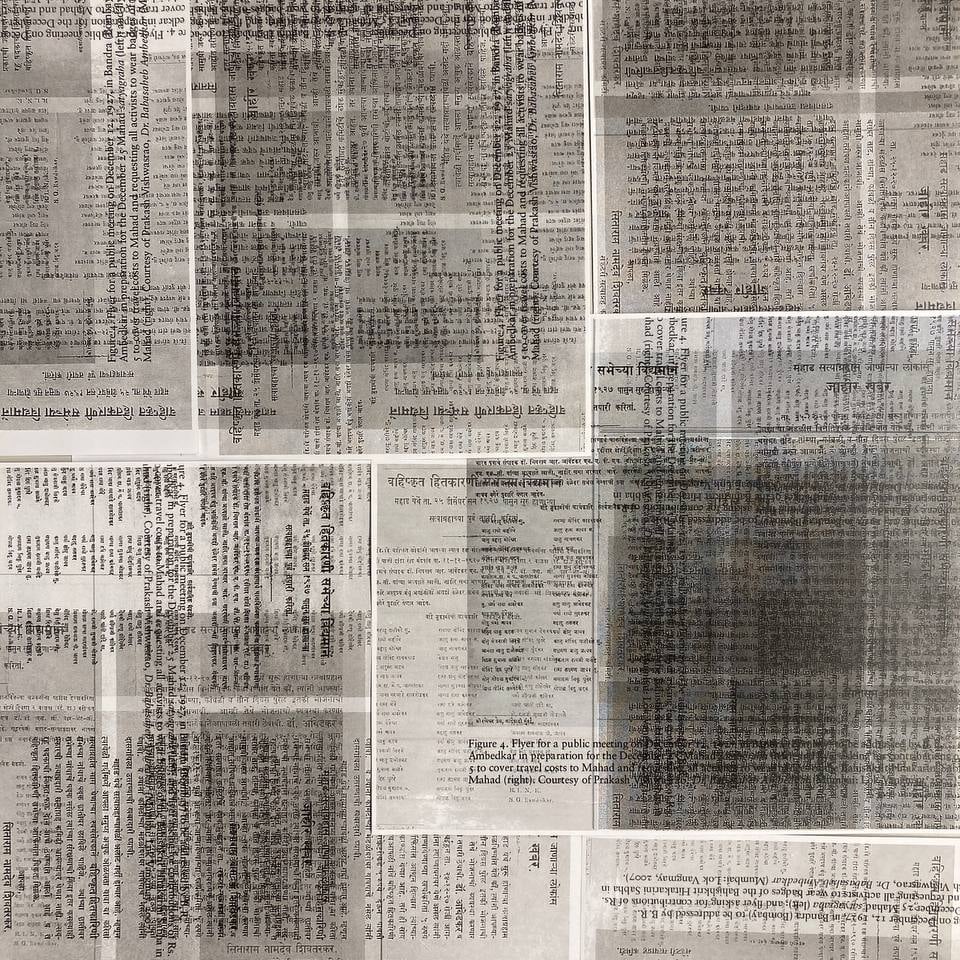
The exhibition series Revolutionary Remembrance is part of the artistic research project Commemorating a Revolution yet to come, which seeks to critically reflect on the politics of remembrance by taking as its focal point the revolutionary actions that unfolded in Mahad, Maharashtra, in 1927. Under the leadership of Dr. Ambedkar, Dalits asserted their rights by drinking water from a well that had been socially forbidden to them within the Hindu religio-social system. Later that year, over ten thousands Dalits gathered again in Mahad together with Dr. Ambedkar for the ritualistic burning of the Hindu text Manusmriti – the text in which the caste system is said to have been formalised.
This occasion is marked every year in Mahad through commemorative events and celebrations that draw people from across India to pay their respects. As part of remembering this revolutionary moment, we are organising the first edition of the exhibition series at the Dr. Babasaheb Ambedkar National Memorial in Mahad.
Through this exhibition series, we aim to broaden our perspective and see intersections of how artists have remembered other revolution(s)/revolutionary moments. Anchored in the specificity of Mahad and the radical actions led by Dr. Ambedkar, we seek to reflect upon the very idea of revolution. What emerges when we observe, side by side, for instance, a mothers’ protest in Taksim Square in Istanbul; and the protests demanding accountability for the 43 students forcibly dissparead in Mexico; a candle light vigil in New Delhi, with the farmer’s protest in Punjab; or the ongoing histories of exploitative international mining in the former Yugoslavia? How do protest songs from Orissa which resist corporatisation resonate within Mahad? When juxtaposed with each other - especially in a city marked by historical radical actions – might these varied ways of looking, reflection and thinking offer a different understanding of radicality or of revolution itself? Are these instances acts of remembering revolutions or do they constitute forms of radical remembering? What, then, might the term revolutionary remembrance truly stand for?
Can such juxtapositions open a conversation among social movements from different geographies and contexts, each engaging with the commemoration of social movements in their own way? WIll this help us trigger reflections on politics of remembrance? On how can we create a space of continuous remembrance, a remembrance that opposes an objectified, commodified and digestible past, but one that allows for the complexities, the intersections, the incoherencies, the nonlinearity, the uneventfulness, the persistent, the unspectacular?
In looking at the past and remembering from the here and now, can we together imagine a revolution?
curatorial note
Contact/संपर्क
Contact/ संपर्क
© 2025. All rights reserved.
This website is part of the artistic research project Commemorating a Revolution Yet to Come (funded by FWF PEEK and hosted at the Academy of Fine Arts, Vienna),